The Crucible - The JRTC Experience Podcast
The Joint Readiness Training Center is the premier crucible training experience. We prepare units to fight and win in the most complex environments against world-class opposing forces. We are America’s leadership laboratory. This podcast isn’t an academic review of historical vignettes or political-science analysis of current events. This is a podcast about warfighting and the skillsets necessary for America’s Army to fight and win on the modern battlefield.









Episodes
Jun 10, 2026
Jun 10, 2026
38 min
The Joint Readiness Training Center is pleased to present the one-hundredth-and-sixty-first episode to air on ‘The Crucible - The JRTC Experience.’ Hosted by the Senior Enlisted Medical Advisor and Role II Observer-Coach-Trainer for the Task Force Sustainment (BSB / CSSB), MSG Timothy Sargent on behalf of the Commander of Ops Group (COG). Today’s guests are four seasoned senior NCOs within one of our infantry task forces. CSM Edwards Cumming is the TF CSM, 1SG Jeremiah Guerra is a CO Team 1SG, 1SG Mark Varley is a CO Team 1SG, and SFC William Deutsch is the Senior Medical Observer – Coach – Trainer within Task Force 3 (IN BN).
This episode explores the critical relationship between casualty care and maneuver operations, emphasizing that medical support cannot exist separately from the fight. Leaders discuss how the realities of Large Scale Combat Operations are forcing units to rethink long-held assumptions developed during the counterinsurgency era, particularly the expectation of rapid evacuation and uncontested medical support. Topics include self-aid, buddy-aid, casualty collection points (CCPs), ambulance exchange points (AXPs), casualty evacuation (CASEVAC), mass casualty planning, and the difficult balance between continuing the mission and treating the wounded. A recurring theme throughout the discussion is that survivability begins at the point of injury, and units that fail to train Soldiers on individual and buddy care often experience significantly higher rates of preventable losses. The episode reinforces that casualty care is not solely a medical responsibility—it is a leader responsibility that must be integrated into every operation from planning through execution.
The conversation also focuses on the importance of integrating medical personnel into the planning process at every echelon. Leaders highlight common shortcomings observed at JRTC, including poorly understood medical SOPs, ineffective CCP placement, underutilization of AXPs, and failure to include medical NCOs and medics in MDMP, rehearsals, and tactical planning. Additional discussion centers on building combat-ready medics who understand maneuver operations, establishing trust between medics and line units, developing casualty evacuation plans that are realistic for contested environments, and training medical tasks during everyday operations rather than treating them as standalone events. Ultimately, the episode argues that successful casualty care in LSCO requires synchronization between the medical and maneuver enterprises, disciplined planning, aggressive training, and leaders who understand that integrating medical capabilities into the fight saves lives while preserving combat power.
Part of S03 “Lightfighter Lessons” series.
For additional information and insights from this episode, please check-out our Instagram page @the_jrtc_crucible_podcast.
Be sure to follow us on social media to keep up with the latest warfighting TTPs learned through the crucible that is the Joint Readiness Training Center.
Follow us by going to: https://linktr.ee/jrtc and then selecting your preferred podcast format.
Again, we’d like to thank our guests for participating. Don’t forget to like, subscribe, and review us wherever you listen or watch your podcasts — and be sure to stay tuned for more in the near future.
“The Crucible – The JRTC Experience” is a product of the Joint Readiness Training Center.
May 29, 2026
May 29, 2026
41 min
The Joint Readiness Training Center is pleased to present the one-hundredth-and-sixtieth episode to air on ‘The Crucible - The JRTC Experience.’ Hosted by CSM James Miller, the Command Sergeant Major of 1-509th IN (OPFOR), known as Geronimo, on behalf of the Commander of Operations Group. Today’s guests are subject matter experts on all things defense within Geronimo’s Baker Company: 1SG Larson Palsis, the Baker Co First Sergeant; SFC Woodroof Musser, Platoon Sergeant for 1st PLT; and SSG Joseph DuBrul, Squad Leader for 2nd SQD, 1st PLT.
This episode examines the art and science of conducting a successful defense against a peer threat, using Geronimo’s defensive operations as a framework for discussing proven tactics, techniques, and procedures. The conversation centers on the doctrinal characteristics of the defense—disruption, mass and concentration, security, preparation, flexibility, maneuver, and operations in depth—and how these concepts are applied on a modern battlefield. Leaders discuss the importance of engagement area development, obstacle integration, reconnaissance, early warning systems, and synchronizing direct and indirect fires to create multiple dilemmas for attacking forces. A recurring theme is that successful defenses are not passive. Rather, they are active, intelligence-driven operations designed to disrupt enemy tempo, attrit combat power, and set the conditions for a future counterattack.
The episode also highlights common shortcomings observed among rotational units, particularly in the areas of preparation, time management, communication, and defensive planning. Leaders stress that units often rush through defensive operations after focusing heavily on offensive tasks, resulting in poorly developed engagement areas, inadequate rehearsals, and limited flexibility once contact is made. The discussion reinforces the importance of reconnaissance, reporting, and maintaining a shared understanding across all echelons so commanders can make timely decisions and properly position forces. Additional insights include the value of counterattacks, defense in depth, reserve employment, and building multiple branches and sequels into the plan. Ultimately, the episode argues that the best defensive formations are those that master the fundamentals, aggressively prepare positions, rehearse actions, and continuously adapt faster than the enemy can react.
Part of S11 “Conversations with the Enemy” series.
May 27, 2026
May 27, 2026
36 min
The Joint Readiness Training Center is pleased to present the one-hundredth-and-fifty-ninth episode to air on ‘The Crucible - The JRTC Experience.’ Hosted by MAJ David Pfaltzgraff, the Brigade Executive Officer Observer – Coach – Trainer and MAJ Marc Howle, the Brigade Senior Engineer / Protection OCT for the Brigade Command & Control (BDE HQ), on behalf of the Commander of Ops Group (COG). Today’s guests are subject matter experts across JRTC’s Plans / Exercise Maneuver Control: MAJ Amy Beatty, the Senior G-4 Sustainment Planner and CPT Cody Kindle, an S-4 Sustainment Planner. (MAJ Beatty was formerly the TF Executive Officer OCT for Task Force Sustainment (CSSB / LSB).)
This episode continues the discussion on base cluster employment TTPs, diving deeper into how sustainment formations are adapting Brigade Support Area operations for survivability and effectiveness on the modern battlefield. The conversation focuses heavily on the realities of dispersing sustainment nodes, balancing survivability against operational efficiency, and the growing complexity of terrain management inside the brigade support area. Leaders discuss the challenges of deconflicting land with artillery positions, planning secondary and tertiary displacement sites, and integrating engineers into survivability efforts for sustainment formations. A major theme throughout the episode is that sustainment survivability is a brigade fight requiring close coordination between sustainers, engineers, fires, and maneuver staffs to properly prioritize protection, movement, and terrain allocation. The discussion also highlights how smaller, dispersed base clusters dramatically reduce vulnerability compared to the legacy “massive BSA” model, but at the cost of increased manpower demands, complexity, and command-and-control challenges.
The episode also explores the difficult balance between displacement and survivability in a battlefield dominated by drones, indirect fires, and persistent surveillance. Leaders debate whether sustainment nodes are safer moving or remaining dug in, emphasizing that displacement itself creates risk due to large convoy signatures and limited protected routes. Additional topics include work-rest cycles, security requirements, noise and light discipline, and the importance of conducting detailed manpower calculations before arriving at JRTC. A recurring lesson learned is that sustainment units must deliberately train base cluster operations at home station rather than attempting to improvise them during a rotation. The discussion highlights one Light Support Battalion that successfully avoided detection by OPFOR through exceptional camouflage, dispersion, and discipline, reinforcing that survivability on the modern battlefield often depends less on technology and more on disciplined fundamentals and thoughtful planning. Ultimately, the episode frames base cluster operations as a constantly evolving balance between protection, sustainment throughput, mobility, and operational tempo in large scale combat operations.
Part of S13 “Hip Pocket Training” series.
For additional information and insights from this episode, please check-out our Instagram page @the_jrtc_crucible_podcast
Be sure to follow us on social media to keep up with the latest warfighting TTPs learned through the crucible that is the Joint Readiness Training Center.
Follow us by going to: https://linktr.ee/jrtc and then selecting your preferred podcast format.
Again, we’d like to thank our guests for participating. Don’t forget to like, subscribe, and review us wherever you listen or watch your podcasts — and be sure to stay tuned for more in the near future.
“The Crucible – The JRTC Experience” is a product of the Joint Readiness Training Center.
May 22, 2026
May 22, 2026
40 min
The Joint Readiness Training Center is pleased to present the one-hundredth-and-fifty-eighth episode to air on ‘The Crucible - The JRTC Experience.’ Hosted by MAJ Will Montoya, the Multi-Domain Effects Cell Chief for 1-509th IN (OPFOR), known as Geronimo, on behalf of the Commander of Operations Group. Today’s guests are subject matter experts on drone warfare within Geronimo: SGT Colin Rock, SGT Darius Shumpert, and SPC Collin Palm. SGT Rock is a Team Leader and drone operator for Able Company, 1-509th IN (OPFOR). SGT Shumpert and SPC Palm are first person viewer small unmanned aircraft systems operators for MDEC, 1-509th IN (OPFOR).
This episode dives into the evolving employment of small unmanned aircraft systems (sUAS) from the perspective of Geronimo’s Multi-Domain Effects Cell (MDEC), focusing heavily on practical TTPs, rapid battlefield adaptation, and lessons learned from observing modern conflicts like Ukraine. The discussion explores the full spectrum of drone employment—from ISR and route reconnaissance to one-way attack FPVs, heavy-lift “mothership” drones, and autonomous strike systems. A major theme throughout the episode is the incredible pace of innovation in drone warfare, where countermeasures and counter-countermeasures evolve in cycles measured in weeks rather than years. Leaders discuss how cheap, expendable systems are reshaping battlefield economics by destroying million-dollar platforms, compressing the kill chain, and creating persistent threats that traditional formations are not yet fully prepared to handle. The episode also reinforces that drones are not replacing soldiers, but instead dramatically increasing the lethality, reach, and survivability of small units when properly integrated.
The conversation also focuses heavily on the Army’s current training and organizational gaps regarding sUAS employment. Topics include FPV pilot skill development, simulator training, procurement challenges, autonomous targeting systems, airspace integration, electromagnetic warfare threats, and the need for dedicated drone specialists at echelon. Geronimo operators stress that not every Soldier can effectively fly advanced FPV systems, arguing that drone operations should become a formalized specialty or additional skill identifier similar to sniper or joint fires qualifications. Additional insights include the importance of “mothership” resupply concepts, loitering munitions, fiber-optic drones resistant to jamming, and the requirement for units to develop realistic reactions to drone threats instead of treating them as novelty systems. Ultimately, the episode frames drone warfare as one of the most significant battlefield evolutions in generations, requiring the Army to rethink training, procurement, survivability, and tactical employment before facing these threats in real combat.
Part of S11 “Conversations with the Enemy” series.
For additional information and insights from this episode, please check-out our Instagram page @the_jrtc_crucible_podcast.
Be sure to follow us on social media to keep up with the latest warfighting TTPs learned through the crucible that is the Joint Readiness Training Center.
Follow us by going to: https://linktr.ee/jrtc and then selecting your preferred podcast format.
Again, we’d like to thank our guests for participating. Don’t forget to like, subscribe, and review us wherever you listen or watch your podcasts — and be sure to stay tuned for more in the near future.
“The Crucible – The JRTC Experience” is a product of the Joint Readiness Training Center.
May 20, 2026
May 20, 2026
42 min
The Joint Readiness Training Center is pleased to present the one-hundredth-and-fifty-seventh episode to air on ‘The Crucible - The JRTC Experience.’ Hosted by MAJ David Pfaltzgraff, the Brigade Executive Officer Observer – Coach – Trainer and MAJ Marc Howle, the Brigade Senior Engineer / Protection OCT for the Brigade Command & Control (BDE HQ), on behalf of the Commander of Ops Group (COG). Today’s guests are subject matter experts across JRTC: MAJ Charles “Dave” Johansen, CPT George Slawski, and SFC Brian Reigle. MAJ Johansen is the BDE Senior CBRN OIC OCT for Brigade Command & Control (BDE HQ). CPT Slawski is the BN CBRN OIC OCT for TF-5 (Enablers). And SFC Reigle is the CBRN NCOIC OCT for TF-2 (IN BN).
This episode explores Chemical, Biological, Radiological, and Nuclear (CBRN) operations at the brigade level, focusing on the realities of integrating CBRN planning into Large Scale Combat Operations rather than treating it as a standalone specialty. A major theme throughout the discussion is that units consistently fail to plan for CBRN requirements before arriving in Torbia, particularly when it comes to sustainment, logistics, and protection integration. Topics include MOPP levels, decontamination planning, JSLIST forecasting, water requirements, toxic industrial chemicals/materials (TICs/TIMs), and the challenges of operating in contaminated environments while maintaining tempo. The panel emphasizes that CBRN should not exist in isolation; it must be integrated into MDMP, protection working groups, intelligence preparation of the battlefield, and sustainment planning from the very beginning.
The conversation also focuses heavily on the underutilization of CBRN officers, NCOs, and reconnaissance assets at echelon. Leaders discuss how many brigade and battalion staffs fail to integrate CBRN personnel into planning processes, often relegating them to secondary duties instead of leveraging them as subject matter experts during operations. Additional topics include chemical reconnaissance platoons, detection and contamination management equipment, command-and-support relationships, and the importance of home-station training that extends far beyond the gas chamber. The episode reinforces that success in a contaminated battlefield environment depends on aggressive program ownership, staff integration, confidence from CBRN leaders, and building foundational proficiency across the force before arriving at combat training centers. Ultimately, the discussion frames CBRN not as a niche capability, but as a core component of protection and battlefield survivability in modern warfare.
Part of S13 “Hip Pocket Training” series.
For additional information and insights from this episode, please check-out our Instagram page @the_jrtc_crucible_podcast
Be sure to follow us on social media to keep up with the latest warfighting TTPs learned through the crucible that is the Joint Readiness Training Center.
Follow us by going to: https://linktr.ee/jrtc and then selecting your preferred podcast format.
Again, we’d like to thank our guests for participating. Don’t forget to like, subscribe, and review us wherever you listen or watch your podcasts — and be sure to stay tuned for more in the near future.
“The Crucible – The JRTC Experience” is a product of the Joint Readiness Training Center.
May 16, 2026
May 16, 2026
57 min
The Joint Readiness Training Center is pleased to present the one-hundredth-and-fifty-sixth episode to air on ‘The Crucible - The JRTC Experience’. Hosted by MAJ David Pfaltzgraff, the Brigade Executive Officer Observer – Coach – Trainer and MAJ Marc Howle, the Brigade Senior Engineer / Protection OCT for the Brigade Command & Control (BDE HQ), on behalf of the Commander of Ops Group (COG). Today’s guests are two of the Army’s most seasoned noncommissioned officers: CSM Raymond Harris, Command Sergeant Major of Transformation and Training Command (T2COM) and CSM(Retired) Todd Sims, the 23rd Command Sergeant Major of Forces Command (FORSCOM).
The Army is undergoing one of its most significant organizational transformations in decades with the transition away from the legacy structures of United States Army Forces Command and United States Army Training and Doctrine Command toward the newly established Transformation and Training Command and Western Hemisphere Command constructs. This shift is designed to better align Army force generation, experimentation, modernization, and readiness with the demands of large scale combat operations and regionally aligned combatant command requirements. Under the new framework, T2COM integrates force design, training, experimentation, doctrine, and leader development into a single organization capable of rapidly testing and refining future warfighting concepts, while WHC focuses on force readiness and operational alignment across the Western Hemisphere. Together, the changes are intended to increase speed, scale, and adaptability across the Army as it prepares for increasingly contested, multi-domain conflict environments.
This episode discusses Army transformation, modernization, and the importance of maintaining the fundamentals while adapting to the realities of the modern battlefield. The conversation explores how the Army is leveraging the Combat Training Centers (CTCs) as large-scale experimentation platforms to test new formations, equipment, and concepts before integrating them across the force. Topics include Transformation in Contact (TiC), experimentation with new technologies, and how the Army is trying to close the gap between emerging capabilities and operational readiness by getting equipment into soldiers’ hands earlier for home-station training. A major theme throughout the episode is that no amount of technology can replace disciplined fieldcraft, security, camouflage, and leadership. The discussion repeatedly reinforces that soldiers must still master the basics—digging fighting positions, reducing electromagnetic signatures, rehearsing battle drills, and maintaining security—even while integrating drones, autonomous systems, and other modern capabilities into operations.
The episode also dives into leadership development, sustainment in contested environments, and the evolving role of Noncommissioned Officers in preparing formations for Large Scale Combat Operations. Leaders discuss how modern warfare has eliminated the idea of “safe areas,” forcing every formation—including sustainment units—to think about survivability, protection, and electromagnetic concealment. Additional topics include lessons from Ukraine, the integration of drone threat response into Army training, changes to NCO Professional Military Education, and the importance of honest feedback loops between soldiers, units, and senior leaders to improve equipment and doctrine. Throughout the discussion, the speakers emphasize that effective leadership remains the decisive factor in combat power: leaders must be present, committed, and relentlessly focused on preparing their soldiers for the harsh realities of ground combat. Ultimately, the episode frames modernization not as replacing the human element of warfare, but as enhancing disciplined, cohesive teams capable of adapting and surviving in increasingly complex multi-domain environments.
Part of S01 “The Leader’s Laboratory” series.
For additional information and insights from this episode, please check-out our Instagram page @the_jrtc_crucible_podcast.
Be sure to follow us on social media to keep up with the latest warfighting TTPs learned through the crucible that is the Joint Readiness Training Center.
Follow us by going to: https://linktr.ee/jrtc and then selecting your preferred podcast format.
Again, we’d like to thank our guests for participating. Don’t forget to like, subscribe, and review us wherever you listen or watch your podcasts — and be sure to stay tuned for more in the near future.
“The Crucible – The JRTC Experience” is a product of the Joint Readiness Training Center.
May 13, 2026
May 13, 2026
39 min
The Joint Readiness Training Center is pleased to present the one-hundredth-and-fifty-sixth episode to air on ‘The Crucible - The JRTC Experience.’ Hosted by MAJ David Pfaltzgraff, the Brigade Executive Officer Observer – Coach – Trainer and MAJ Marc Howle, the Brigade Senior Engineer / Protection OCT for the Brigade Command & Control (BDE HQ), on behalf of the Commander of Ops Group (COG). Today’s guests are subject matter experts within JRTC’s Brigade Command & Control (BDE HQ) task force: MAJ Michael Stewart, the BDE S-3 Operations Officer OCT; MAJ Steve Yates, the BDE S-6 Signal Officer-in-Charge; CW2 Christopher Puthoff, the BDE S-6 Signal Planner; and MSG Randell Conway, the BDE Intelligence NCOIC OCT.
This episode explores the challenges of establishing and maintaining a common operating picture (COP) in support of command and control during large scale combat operations. The discussion emphasizes that a COP is far more than a digital map with graphics—it is the collection of synchronized fighting products, graphics, timelines, and running estimates that enable commanders and staffs to understand and control operations across space and time. Leaders stress that units often become overly reliant on technology while neglecting the fundamentals of analog systems and collaborative planning. A recurring theme is that the best COPs are built through deliberate staff collaboration, standardized products, and continuous refinement, rather than simply relying on software or digital platforms to generate shared understanding. The episode reinforces that a COP only becomes “common” when every echelon understands, updates, and actively contributes to it.
The conversation also dives into the friction points that routinely degrade command and control at JRTC, including poor knowledge management, lack of standardization, excessive digital clutter, outdated graphics, and inconsistent reporting from subordinate units. Leaders discuss the importance of maintaining both analog and digital COPs, especially in austere environments where weather, terrain, or system failures can rapidly degrade digital systems. Topics such as operation synchronization meetings, battle rhythm discipline, layer management, graphic refinement, and bottom-up feedback are explored as essential practices for maintaining shared understanding across the formation. Ultimately, the episode argues that effective command and control is less about technology and more about disciplined processes, rehearsed SOPs, collaborative planning, and ensuring the entire organization—from brigade to company level—is operating from the same understanding of the battlefield.
Part of S13 “Hip Pocket Training” series.
For additional information and insights from this episode, please check-out our Instagram page @the_jrtc_crucible_podcast
Be sure to follow us on social media to keep up with the latest warfighting TTPs learned through the crucible that is the Joint Readiness Training Center.
Follow us by going to: https://linktr.ee/jrtc and then selecting your preferred podcast format.
Again, we’d like to thank our guests for participating. Don’t forget to like, subscribe, and review us wherever you listen or watch your podcasts — and be sure to stay tuned for more in the near future.
“The Crucible – The JRTC Experience” is a product of the Joint Readiness Training Center.
May 8, 2026
May 8, 2026
44 min
The Joint Readiness Training Center is pleased to present the one-hundredth-and-fifty-fourth episode to air on ‘The Crucible - The JRTC Experience.’ Hosted by MAJ Amy Beatty, the G-4 Senior Sustainment Planner from Plans / Exercise Maneuver Control Task Force on behalf of the Commander of Ops Group (COG). Today’s guests are subject matter experts across JRTC: CSM Edward Cummings is the Task Force Command Sergeant Major Observer-Coach-Trainer for TF-3 (IN BN) and CPT Cody Kindle the S-4 Sustainment Planner for JRTC’s Plans / EMC TF.
This episode explores the realities of brigade sustainment on the modern battlefield from both the maneuver and sustainer perspectives, focusing on how logistics directly drives tempo, survivability, and operational reach in large scale combat operations. The discussion highlights the growing tension between what maneuver forces want and what sustainment systems can realistically support, especially within the Army’s evolving force structure where combat logistics companies (CLCs) are significantly smaller than the legacy forward support companies they replaced. Leaders examine how inaccurate LOGSTATs, poor running estimates, and “lazy logistics” create cascading problems that can culminate not only brigades, but entire divisions. From the infantry perspective, the episode emphasizes that sustainment must remain synchronized with maneuver operations, because units that outrun their logistics eventually lose momentum, combat power, and freedom of action.
The conversation also dives into practical sustainment solutions and best practices observed at JRTC, including “no wasted calories” backhaul operations, trickle resupply concepts, standardized vehicle load plans, and the importance of continuously updating running estimates instead of blindly trusting planning factors. A major theme is that sustainment is fundamentally a human and leadership problem, requiring trust between maneuver leaders and sustainers at every echelon. Topics such as water distribution, casualty evacuation tied to resupply, sustainment node survivability, and balancing push versus pull logistics are discussed in detail. The episode reinforces that sustainers must think beyond simply delivering commodities and instead focus on generating options and decision space for commanders. Ultimately, the discussion frames sustainment as a decisive component of combat power that requires disciplined planning, accurate forecasting, adaptive leadership, and full integration with the maneuver fight to survive and win on a transparent, contested battlefield.
Part of S05 “Beans, Bullets, Band-Aids, Batteries, Water, & Fuel” series.
For additional information and insights from this episode, please check-out our Instagram page @the_jrtc_crucible_podcast.
Be sure to follow us on social media to keep up with the latest warfighting TTPs learned through the crucible that is the Joint Readiness Training Center.
Follow us by going to: https://linktr.ee/jrtc and then selecting your preferred podcast format.
Again, we’d like to thank our guests for participating. Don’t forget to like, subscribe, and review us wherever you listen or watch your podcasts — and be sure to stay tuned for more in the near future.
“The Crucible – The JRTC Experience” is a product of the Joint Readiness Training Center.
What is JRTC?
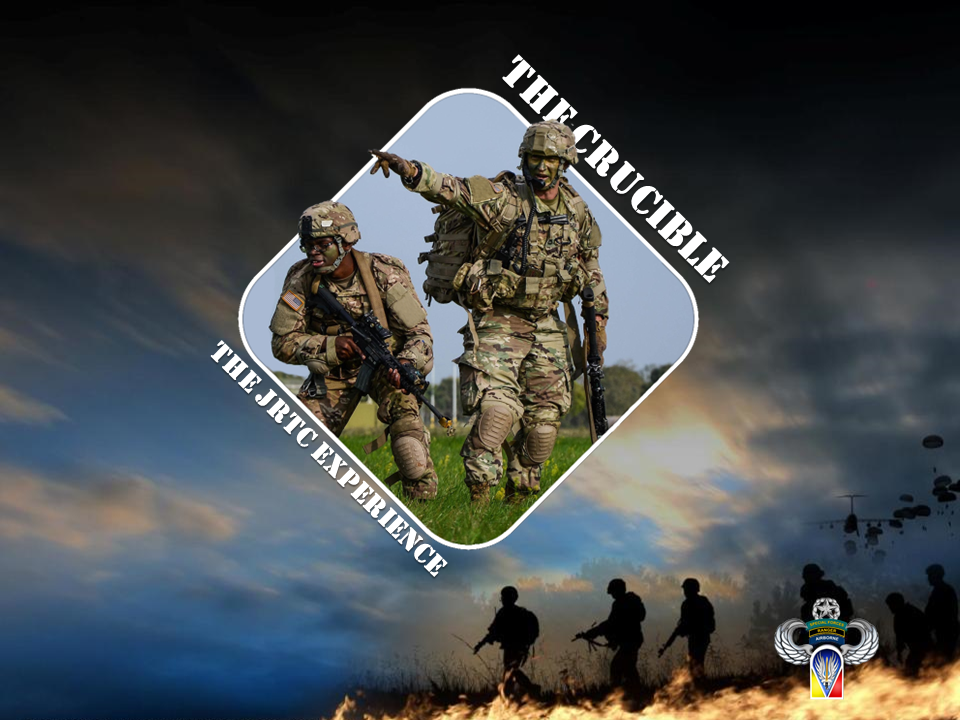
The Joint Readiness Training Center is the premier crucible training experience. We prepare units to fight and win in the most complex environments against world-class opposing forces. We are America’s leadership laboratory.
The Crucible
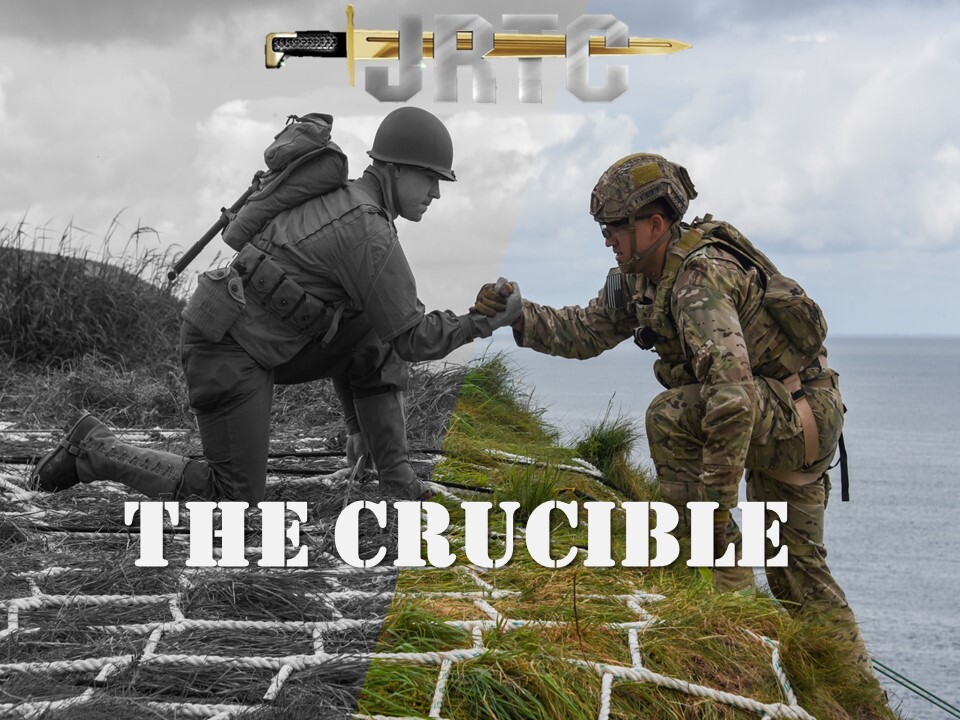
The crucible that is the JRTC experience is an arduous ordeal every unit must go through to certify their readiness. It tests every leader and the unit collectively physically, mentally, and morally and is the defining experience of collective training. The crucible takes place over fourteen days of force-on-force as part of a decisive action training exercise, where leaders and units are continuously food & sleep deprived, harassed by opposition forces, and generally under duress.
The bottom line is this—the crucible at the JRTC is a rite of passage that, through shared sacrifice, leaders and units will never forget. With that memory and the core warfighting skills honed throughout this training exercise, they will be able to face any challenges in their path allowing them to fight and win on the modern battlefield.