The Crucible - The JRTC Experience Podcast
The Joint Readiness Training Center is the premier crucible training experience. We prepare units to fight and win in the most complex environments against world-class opposing forces. We are America’s leadership laboratory. This podcast isn’t an academic review of historical vignettes or political-science analysis of current events. This is a podcast about warfighting and the skillsets necessary for America’s Army to fight and win on the modern battlefield.
Listen on:









Episodes
Wednesday Dec 10, 2025
Wednesday Dec 10, 2025
The Joint Readiness Training Center is pleased to present the one-hundredth-and-eighteenth episode to air on ‘The Crucible - The JRTC Experience.’ Hosted by the Senior Enlisted Medical Advisor and Role II Observer-Coach-Trainer for the Task Force Sustainment (BSB / CSSB), MSG Timothy Sargent on behalf of the Commander of Ops Group (COG). Today’s guests are all combat medicine professionals across the JRTC. SFC William Deutsch is the Senior Medical OCT with TF-3 (IN BN), SFC Robert Schimmelpfenneg is the Medical Advisor and Role II OCT with TF Sustainment (BSB / CSSB), and SFC Anthony Norris is the Senior Medical OCT with Live Fire Division.
This episode dives deep into combat medicine at the tactical small-unit level, focusing on what 68W medics truly face in a large-scale combat operations environment. The discussion highlights how today’s medics arrive from Basic Combat Training and Advanced Individual Training with significantly more clinical capability: whole blood transfusions, chest tubes, finger thoracotomies, FAST exams, etc. Yet often lose proficiency once they reach their units due to lack of repetitions, limited clinical exposure, and competing taskings like motor-pool duties and gate guard. The panel emphasizes the widening gap between what new medics learn in the schoolhouse and what line units actually reinforce day to day. Just as importantly, the episode stresses that modern LSCO demands a return to mastery of basics: triage under mass-casualty conditions, reassessments, deliberate casualty collection point (CCP) management, documentation, and base-level soldier tasks such as security, dispersion, movement, and survivability. We routinely observe high-casualties at JRTC, often 60–80 casualties at once and hundreds per rotation. Poor triage and poor soldier-skill fundamentals, not lack of “sexy medicine,” are the leading causes of died-of-wounds outcomes.
The episode also examines how units can better sustain medical readiness during home-station training. Leaders discuss integrating medics into ER rotations, EMS ride-alongs, sick-call operations, and realistic trauma/medical lanes that reinforce both prolonged field care and everyday DMBI cases. They argue that NCOs must reclaim ownership of training through proper DTMS programming, use of existing doctrinal resources, and deliberate linkage to mission-essential tasks. The conversation closes on three high-value priorities for the future fight: deliberate triage, accurate/documented patient care, and competent CCP & CASEVAC execution—all grounded in disciplined soldiering, not just advanced interventions. Ultimately, the episode makes clear that on the LSCO battlefield, combat medics must be clinicians, communicators, and soldiers, capable of saving lives while enabling commanders to maintain combat power forward.
Part of S05 “Beans, Bullets, Band-Aids, Batteries, Water, & Fuel” series.
For additional information and insights from this episode, please check-out our Instagram page @the_jrtc_crucible_podcast
Be sure to follow us on social media to keep up with the latest warfighting TTPs learned through the crucible that is the Joint Readiness Training Center.
Follow us by going to: https://linktr.ee/jrtc and then selecting your preferred podcast format.
Again, we’d like to thank our guests for participating. Don’t forget to like, subscribe, and review us wherever you listen or watch your podcasts — and be sure to stay tuned for more in the near future.
“The Crucible – The JRTC Experience” is a product of the Joint Readiness Training Center.
Wednesday Nov 26, 2025
Wednesday Nov 26, 2025
The Joint Readiness Training Center is pleased to present the one-hundredth-and-seventeenth episode to air on ‘The Crucible - The JRTC Experience.’ Hosted by MAJ Marc Howle, the Brigade Senior Engineer / Protection Observer-Coach-Trainer, and MAJ David Pfaltzgraff, BDE S-3 Operations OCT, from Brigade Command & Control (BDE HQ) on behalf of the Commander of Ops Group (COG). Today’s guests are senior members of JRTC’s fires support enterprise: MAJ Jeff Horn, MSG Esteban Melendez, and SFC Larry Gillispie, Jr. MAJ Horn is the Executive Officer OCT for the Fires Support Task Force. MSG Melendez is the Battery Senior NCO OCT and SFC Gillispie is the Fires Direction Center Senior OCT for the Fires Support TF.
This episode centers on the critical role of indirect fires in enabling brigade and battalion maneuver during large-scale combat operations (LSCO). Discussion emphasized how modern battlefields—defined by continuous observation, rapid enemy counterfire, and contested electromagnetic terrain—demand faster, simpler, and more integrated fires processes. The episode explored the necessity of marrying intelligence, targeting, and maneuver to generate timely and accurate effects, noting that units frequently struggle with building effective EVENTEMPs, aligning priority intelligence requirements with high-payoff target lists, and ensuring fire support elements understand the commander’s visualization. Indirect fires are no longer a supporting arm that can be “plugged in” at the end of planning; instead, fires must lead maneuver, set conditions, disrupt enemy reconnaissance, and shape the tempo of operations. Units that succeeded at JRTC did so by developing disciplined fires rehearsals, maintaining digital pathways for observers and FSEs, and employing simple, survivable fire support plans that could be executed under degraded conditions.
The episode also examined common shortfalls in fire support execution and provided practical solutions rooted in LSCO best practices. Many units struggled to connect sensors to shooters, often due to poor task organization, inconsistent digital connectivity, or a lack of rehearsed triggers and decision points. The conversation stressed that fires must be integrated early, beginning at WARNO 1, so that reconnaissance, counter-reconnaissance, and targeting all feed a coherent fires architecture. Leaders must enforce conditions that enable fires in contact: dispersed artillery positions, rapid survivability moves, redundant communications, and timely, accurate reporting. Best practices discussed included using decoys to force enemy action, leveraging sUAS for battle damage assessment and real-time refinement, simplifying TLWS/TTLODAC products, and conducting thorough fires technical rehearsals. Ultimately, the episode reinforced that mastery of indirect fires is inseparable from mastery of LSCO itself—units that can sense, decide, and deliver effects faster than the enemy preserve freedom of maneuver and dominate the fight.
Part of S13 “Hip Pocket Training” series.
For additional information and insights from this episode, please check-out our Instagram page @the_jrtc_crucible_podcast
Be sure to follow us on social media to keep up with the latest warfighting TTPs learned through the crucible that is the Joint Readiness Training Center.
Follow us by going to: https://linktr.ee/jrtc and then selecting your preferred podcast format.
Again, we’d like to thank our guests for participating. Don’t forget to like, subscribe, and review us wherever you listen or watch your podcasts — and be sure to stay tuned for more in the near future.
“The Crucible – The JRTC Experience” is a product of the Joint Readiness Training Center.
Wednesday Oct 01, 2025
Wednesday Oct 01, 2025
The Joint Readiness Training Center is pleased to present the one-hundredth-and-sixteenth episode to air on ‘The Crucible - The JRTC Experience.’ Hosted by the Senior Medical Operations Officer Observer-Coach-Trainer for the Task Force Sustainment (BSB / CSSB), CPT Victor Velez on behalf of the Commander of Ops Group (COG). Today’s guest is CPT Christina Pierce, the Officer-in-Charge, Joint Aid Station-Rear (JAS-R) attached to Bayne Jones Army Community Hospital on Fort Polk, LA.
This episode of The Crucible podcast focuses on the coordination and integration of medical operations from Role I through Role 2+, with particular emphasis on the Joint Aid Station-Rear (JAS-R) at the JRTC. The discussion outlines how units often underestimate the staffing, equipment, and Class VIII requirements needed to effectively run a JAS-R. Leaders are reminded that the JAS-R is designed to function as a Role I facility with limited expansion, and its true effectiveness is shaped by what the unit brings—particularly providers, medics, and a robust Class VIII package. A bare minimum staffing model (one provider and 12 medics split across shifts) is described as unsustainable, with best practices suggesting multiple providers and additional medics to manage patient flow, casualty movement, and external appointments. The podcast highlights how equipment such as exam tables, AEDs, suction systems, and crash carts are available in the facility, but units must stock and maintain them.
The conversation further emphasizes coordination with JRTC JAS-R staff and Bayne-Jones Army Community Hospital (BJACH) at Ft. Polk to ensure proper credentialing, MHS Genesis access, and Class VIII ordering prior to arrival. Units are cautioned against arriving with inadequate supplies or relying solely on CTC funds allocation for replenishment, which is intended for sustainment, not initial stocking. Critical points include managing referrals to BJACH and local civilian hospitals, establishing transportation plans for follow-up care, and ensuring effective communication between providers, medics, and the white cell for accountability and patient tracking. The episode stresses that medical planning is not just a surgeon’s responsibility but a command responsibility, and leaders must treat the JAS-R as a training opportunity and readiness rehearsal for the demands of LSCO.
Part of S05 “Beans, Bullets, Band-Aids, Batteries, Water, & Fuel” series.
For additional information and insights from this episode, please check-out our Instagram page @the_jrtc_crucible_podcast
Be sure to follow us on social media to keep up with the latest warfighting TTPs learned through the crucible that is the Joint Readiness Training Center.
Follow us by going to: https://linktr.ee/jrtc and then selecting your preferred podcast format.
Again, we’d like to thank our guests for participating. Don’t forget to like, subscribe, and review us wherever you listen or watch your podcasts — and be sure to stay tuned for more in the near future.
“The Crucible – The JRTC Experience” is a product of the Joint Readiness Training Center.
Wednesday Sep 24, 2025
Wednesday Sep 24, 2025
The Joint Readiness Training Center is pleased to present the one-hundredth-and-fifteenth episode to air on ‘The Crucible - The JRTC Experience.’ Hosted by MAJ Marc Howle, the Brigade Senior Engineer / Protection Observer-Coach-Trainer, and MAJ David Pfaltzgraff, BDE S-3 Operations OCT, from Brigade Command & Control (BDE HQ) on behalf of the Commander of Ops Group (COG). Today’s guests are two senior members of JRTC that most units coordinate with but rarely see in-person: MAJ Jacquelin Marrero and MAJ Brandon Kilthau. MAJ Marrero is the G-4 Sustainment Officer at the Joint Readiness Training Center’s headquarters. MAJ Kilthau is the S-3 Operations Officer for Plans / Exercise Maneuver Control. Plans/EMC plan, resource, and supervise the rotations from start to finish. (Think of the man behind the curtain in the Wizard of Oz.)
This episode focuses on the often-overlooked but decisive phase of reception, staging, onward movement, and integration (RSOI) at JRTC. The discussion highlights recurring friction points as units arrive in Torbia—ranging from poor Soldier discipline and lack of acclimatization to the Louisiana heat, to wasted time at staging areas instead of conducting pre-combat checks (PCCs), pre-combat inspections (PCIs), and final system checks. The key message is mindset: leaders and Soldiers must treat RSOI as the beginning of combat, not downtime before the “real” fight. Units that operationalize RSOI—using the time to validate communications, establish sustainment accounts, rehearse movement, and begin integrating attachments—set the conditions for success. Those that view it as a last break or administrative hurdle often find themselves behind before entering the box.
The conversation also underscores the importance of coordination with the JRTC G4 to ensure prepositioned (“pre-po”) equipment is properly drawn, maintained, and matched to operational requirements. Many units fail to establish essential accounts for Class I, III, IV, V, and VIII supplies until arrival, creating preventable shortfalls. Best practices include using RSOI to rehearse convoy movements, validate communications architecture with available support, and build relationships with enablers or foreign attachments before moving to the training area. Leaders are encouraged to deliberately involve NCOs in these processes to extend command oversight, enforce discipline, and maximize use of time. Ultimately, the episode frames RSOI as more than an administrative requirement: it is the first tactical problem of the rotation, and units that succeed here carry momentum into the fight.
Part of S13 “Hip Pocket Training” series.
For additional information and insights from this episode, please check-out our Instagram page @the_jrtc_crucible_podcast
Be sure to follow us on social media to keep up with the latest warfighting TTPs learned through the crucible that is the Joint Readiness Training Center.
Follow us by going to: https://linktr.ee/jrtc and then selecting your preferred podcast format.
Again, we’d like to thank our guests for participating. Don’t forget to like, subscribe, and review us wherever you listen or watch your podcasts — and be sure to stay tuned for more in the near future.
“The Crucible – The JRTC Experience” is a product of the Joint Readiness Training Center.
Wednesday Sep 17, 2025
Wednesday Sep 17, 2025
The Joint Readiness Training Center is pleased to present the one-hundredth-and-fourteenth episode to air on ‘The Crucible - The JRTC Experience.’ Hosted by MAJ Marc Howle, the Brigade Senior Engineer / Protection Observer-Coach-Trainer, and MAJ David Pfaltzgraff, BDE S-3 Operations OCT, from Brigade Command & Control (BDE HQ) on behalf of the Commander of Ops Group (COG). Today’s guests are two senior sustainers within JRTC: MAJ Amy Beatty, the Task Force Executive Officer from Task Force Sustainment (Combat Sustainment Support Battalion / Brigade Support Battalion) and MAJ Adeniran Dairo, the BDE S-4 Sustainment Observer-Coach-Trainer from Brigade Command & Control (BDE HQ).
This episode on logistics and sustainment in LSCO highlights the recurring friction points’ units face when bringing their formations to JRTC. One of the central themes is the lack of clearly defined roles and responsibilities between the brigade S4 and the SPO. While the S4 is doctrinally responsible for sustainment planning and the SPO for executing those plans, experience gaps, personality differences, and poor coordination often blur the lines. This creates confusion over who produces critical products, such as the sustainment paragraph of the OPORD or synchronization matrices, leading to missed opportunities in planning and execution. The discussion stresses the need for deliberate conversations between S4s and SPOs—ideally starting at home station—to clarify duties, build trust, and ensure planning outputs are synchronized with maneuver requirements.
The conversation also emphasizes the importance of running estimates and the broader framework of the “5 Ls of Logistics”: LOGSTATs, LOGSYNC matrices, LOGSYNC meetings, LOGCOP, and LOGPACs. Too often, junior officers and commodity managers fail to update their estimates as operations progress, leading to mismatched forecasts, overestimations, or shortfalls that erode trust between maneuver and sustainment elements. This disconnect compounds when formations apply blanket percentage increases at each echelon, inflating requirements far beyond reality. Solutions discussed include dual reporting between FSCs and BSBs to balance individual consumption data against bulk stocks, prioritizing survivability over efficiency in sustainment operations, and treating the transition from bulk to individual commodity distribution as a battle drill rehearsed at home station. Ultimately, survivability, trust, and disciplined sustainment practices are framed as decisive factors in ensuring brigades can fight and endure in LSCO.
Part of S13 “Hip Pocket Training” series.
For additional information and insights from this episode, please check-out our Instagram page @the_jrtc_crucible_podcast
Be sure to follow us on social media to keep up with the latest warfighting TTPs learned through the crucible that is the Joint Readiness Training Center.
Follow us by going to: https://linktr.ee/jrtc and then selecting your preferred podcast format.
Again, we’d like to thank our guests for participating. Don’t forget to like, subscribe, and review us wherever you listen or watch your podcasts — and be sure to stay tuned for more in the near future.
“The Crucible – The JRTC Experience” is a product of the Joint Readiness Training Center.
Wednesday Sep 10, 2025
Wednesday Sep 10, 2025
The Joint Readiness Training Center is pleased to present the one-hundredth-and-thirteenth episode to air on ‘The Crucible - The JRTC Experience.’ Hosted by MAJ Marc Howle, the Brigade Senior Engineer / Protection Observer-Coach-Trainer, and MAJ David Pfaltzgraff, BDE S-3 Operations OCT, from Brigade Command & Control (BDE HQ) on behalf of the Commander of Ops Group (COG). Today’s guests are LTC Amoreena “Ammo” York, the Task Force Senior from Aviation Task Force and SSG Nikolas Pappas, the AVN Maintenance Tech Platoon Sergeant from the Aviation Task Force.
This episode of The Crucible podcast delves into the complex realities of sustaining Army rotary-wing aviation units during large-scale combat operations (LSCO). With an emphasis on enabler operations, the discussion highlights three primary friction points aviation units routinely encounter at JRTC: time management in MDMP across multiple simultaneous mission sets, underutilization of NCO expertise in planning and rehearsals, and the technical and doctrinal challenges of Forward Arming and Refueling Points (FARPs). The speakers emphasize that unlike home-station exercises with limited mission scope, JRTC rotations demand that aviation units execute deep attacks, displacements, and air assaults while simultaneously managing logistics and force protection—often without enough time or capacity to rehearse. A key takeaway is the criticality of aggressive MDMP timelines and the use of the “SHOPE” timeline—placing sustainment as the first priority to ensure aviation success.
Further, the episode underscores the need to integrate aviation planning with brigade-level operations, particularly when coordinating terrain management, graphic control measures, and airspace deconfliction. Successful units are those that involve mid-grade NCOs early, especially those with realistic insights into timelines and requirements for tasks like establishing a survivable FARP. The conversation also exposes a widespread lack of familiarity with aviation-specific requirements among brigade and division staff, particularly in managing shared airspace and synchronizing fires and SUAS activity. Finally, the hosts point out that survivable FARPs require camouflage, rapid setup and teardown, and minimal electromagnetic signatures—making blackout comms and distributed rehearsals essential. The episode concludes with a challenge to division-level leaders to solve the enduring problem of rotary-wing sustainment in LSCO through rapid, integrated air logistics—bypassing hours-long convoys and empowering CABs to bridge the final tactical mile.
Part of S13 “Hip Pocket Training” series.
For additional information and insights from this episode, please check-out our Instagram page @the_jrtc_crucible_podcast
Be sure to follow us on social media to keep up with the latest warfighting TTPs learned through the crucible that is the Joint Readiness Training Center.
Follow us by going to: https://linktr.ee/jrtc and then selecting your preferred podcast format.
Again, we’d like to thank our guests for participating. Don’t forget to like, subscribe, and review us wherever you listen or watch your podcasts — and be sure to stay tuned for more in the near future.
“The Crucible – The JRTC Experience” is a product of the Joint Readiness Training Center.
Wednesday Sep 03, 2025
Wednesday Sep 03, 2025
The Joint Readiness Training Center is pleased to present the one-hundredth-and-twelfth episode to air on ‘The Crucible - The JRTC Experience.’ Hosted by the Senior Medical Operations Officer Observer-Coach-Trainer for the Task Force Sustainment (BSB / CSSB), CPT Victor Velez on behalf of the Commander of Ops Group (COG). Today’s guests are subject matter experts in each of their warfighting fields, MAJ Jon Austin, SFC Scott Gallagher, 1LT Andy Cornelison, and LTC Max Ferguson. MAJ Austin is an armor officer from the Close Combat Lethality Task Force at the Maneuver Center of Excellence. SFC Gallagher is the former senior medic for 2-14 IN BN and is currently the Senior Enlisted Medical Advisor OCT for TF Sustainment (BSB / CSSB). 1LT Cornelson is a former Army Special Forces medic and is now the Physician’s Assistant for 2-14 Infantry BN, “Golden Dragons” of 2nd IBCT, 10th Mountain Division. LTC Max Ferguson is the former BN Commander for 2-14 IN BN and is now the G-3 Operations Officer for 10th Mountain DIV as well as serving as the J-3 for the JTF Southern Border.
The 2nd Infantry Brigade Combat Team, 10th Mountain Division, known by its Hollywood call-sign “Commando Brigade”, is a light infantry unit headquartered at Fort Drum, New York. Carrying the proud motto “Courage and Honor,” the brigade traces its lineage to the 10th Mountain Division’s storied World War II legacy in the mountains of Italy, where it earned distinction for its rugged combat effectiveness in extreme terrain. Reactivated in the post-Vietnam era, 2nd IBCT has since deployed multiple times in support of operations in Iraq and Afghanistan, exemplifying rapid deployment capability, adaptability, and lethality. Today, the Commando Brigade remains a cornerstone of the Army’s light infantry force, specializing in mountain and cold-weather operations while preparing for large scale combat operations across multiple domains.
The “golden hour” concept from the Global War on Terror era is being expanded in LSCO to account for prolonged casualty care under contested evacuation timelines. Whole blood and walking blood banks extend treatment coverage, creating larger windows for evacuation to the next level of care. While long practiced within Army Special Operations Forces (ARSOF), this marks the first employment of the concept by a conventional unit in recent history.
In this episode of The Crucible podcast, the panel continues its in-depth discussion on prolonged casualty care (PCC) in large-scale combat operations (LSCO), building on themes introduced in part one. A key focus is on how modern units—especially those operating in austere, isolated, or logistically constrained environments—must adapt to provide lifesaving care when evacuation within the “Golden Hour” is not possible. From operations in Syria and the U.S. southern border to anticipated LSCO scenarios, the conversation highlights the reality that prolonged field care (PFC) is not a future problem—it’s a current operational requirement. We unpack the complexity of holding casualties for hours (or days), examining scenarios where role 1 and 2 facilities become primary treatment centers in the absence of immediate access to surgical capabilities.
The conversation also addresses the practical responsibilities of leaders—both medical and maneuver—in creating the conditions for success. Topics include the importance of tourniquet conversion training, integrating whole-blood programs, designing low-signature CASEVAC platforms, and standardizing tactical combat casualty care (TC3) across formations. Leaders emphasize the need to build experiential knowledge in junior medics through trauma center exposure, paramedic fellowships, and realistic simulation labs. The gap in trauma experience across the force—especially among junior NCOs and medics—is framed as a critical training challenge, compounded by outdated equipment and inconsistent SOPs. The episode concludes with a call to prioritize medics’ professional development, create scalable medical rehearsals nested within maneuver plans, and cultivate confidence in combat casualty care as a decisive enabler in LSCO.
Part of S05 “Beans, Bullets, Band-Aids, Batteries, Water, & Fuel” series.
For additional information and insights from this episode, please check-out our Instagram page @the_jrtc_crucible_podcast
Be sure to follow us on social media to keep up with the latest warfighting TTPs learned through the crucible that is the Joint Readiness Training Center.
Follow us by going to: https://linktr.ee/jrtc and then selecting your preferred podcast format.
Again, we’d like to thank our guests for participating. Don’t forget to like, subscribe, and review us wherever you listen or watch your podcasts — and be sure to stay tuned for more in the near future.
“The Crucible – The JRTC Experience” is a product of the Joint Readiness Training Center.
Thursday Aug 28, 2025
Thursday Aug 28, 2025
The Joint Readiness Training Center is pleased to present the one-hundredth-and-eleventh episode to air on ‘The Crucible - The JRTC Experience.’ Hosted by MAJ Marc Howle, the Brigade Senior Engineer / Protection Observer-Coach-Trainer, and MAJ David Pfaltzgraff, BDE S-3 Operations OCT, from Brigade Command & Control (BDE HQ) on behalf of the Commander of Ops Group (COG). Today’s guests are MAJ Steven Yates, the BDE S-6 Signal OCT from Brigade Command & Control (BDE HQ) and SFC Daniel Pippin, the BN S-6 Signal NCOIC from the 1-509th IN (ABN) Opposing Force.
This episode of The Crucible centers on the challenges of command and control (C2) integration and the employment of enablers within brigade combat teams (BCTs) at JRTC. The discussion highlights recurring issues with overcomplicated signal plans, inadequate COMSEC readiness, and a persistent lack of basic communications skills across maneuver formations. Despite widespread fielding of advanced systems like ITN, many units arrive without validated PACE plans or shared understanding of how to communicate across formations and enabler teams. A key friction point is the failure to execute realistic COMEX and VALEX rehearsals, which often leads to failure in establishing a functioning network prior to movement into the box. When soldiers can’t log into CPCE or MAVEN or don’t know how to employ SATCOM or FM, the entire C2 enterprise falters before first contact.
The episode also stresses the importance of simplifying communications, cross-training non-signal personnel, and involving maneuver leaders in signal planning. A lack of distributed competence creates overreliance on limited 25-series personnel. The team praises aviation’s model of integrating comms training into pilot academics and encourages similar investments at the BCT level—where every Soldier using a radio must understand its function and limitations. Integration of enablers—particularly aviation, foreign partners, and multi-echelon elements like MEC teams—demands proactive coordination well before RSOI. The key takeaway: units that treat RSOI as part of the operations process, not just an administrative requirement, set the conditions for success. C2 must be validated with full mission threads—sensor-to-shooter, PED, and digital fires—before rolling into the box. Anything less risks operational paralysis in the first 48 hours.
Part of S13 “Hip Pocket Training” series.
For additional information and insights from this episode, please check-out our Instagram page @the_jrtc_crucible_podcast
Be sure to follow us on social media to keep up with the latest warfighting TTPs learned through the crucible that is the Joint Readiness Training Center.
Follow us by going to: https://linktr.ee/jrtc and then selecting your preferred podcast format.
Again, we’d like to thank our guests for participating. Don’t forget to like, subscribe, and review us wherever you listen or watch your podcasts — and be sure to stay tuned for more in the near future.
“The Crucible – The JRTC Experience” is a product of the Joint Readiness Training Center.
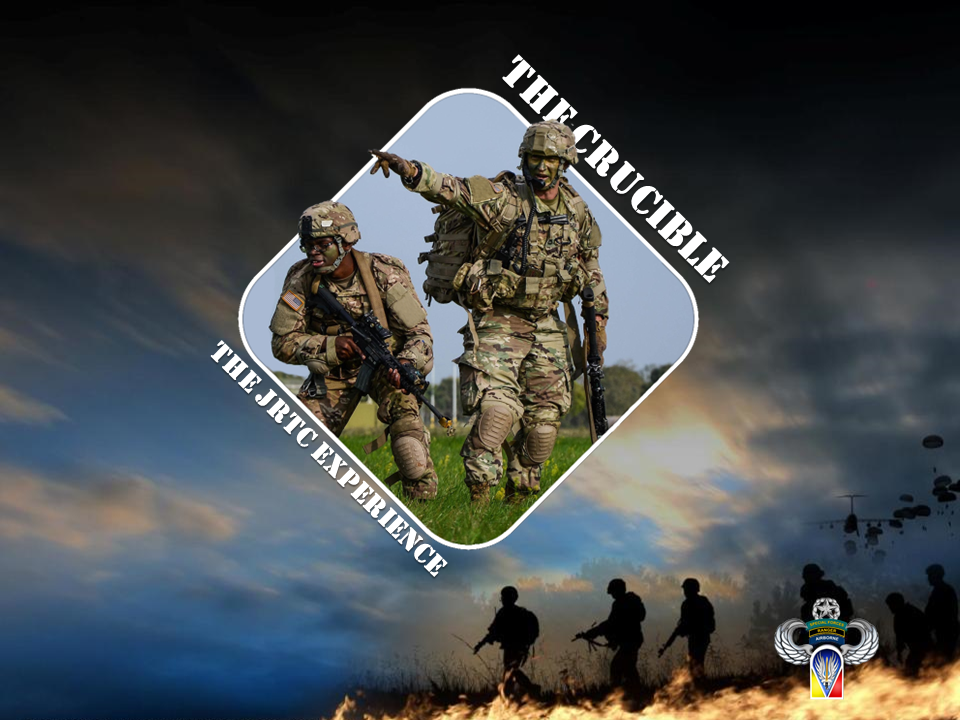
What is JRTC?
The Joint Readiness Training Center is the premier crucible training experience. We prepare units to fight and win in the most complex environments against world-class opposing forces. We are America’s leadership laboratory.
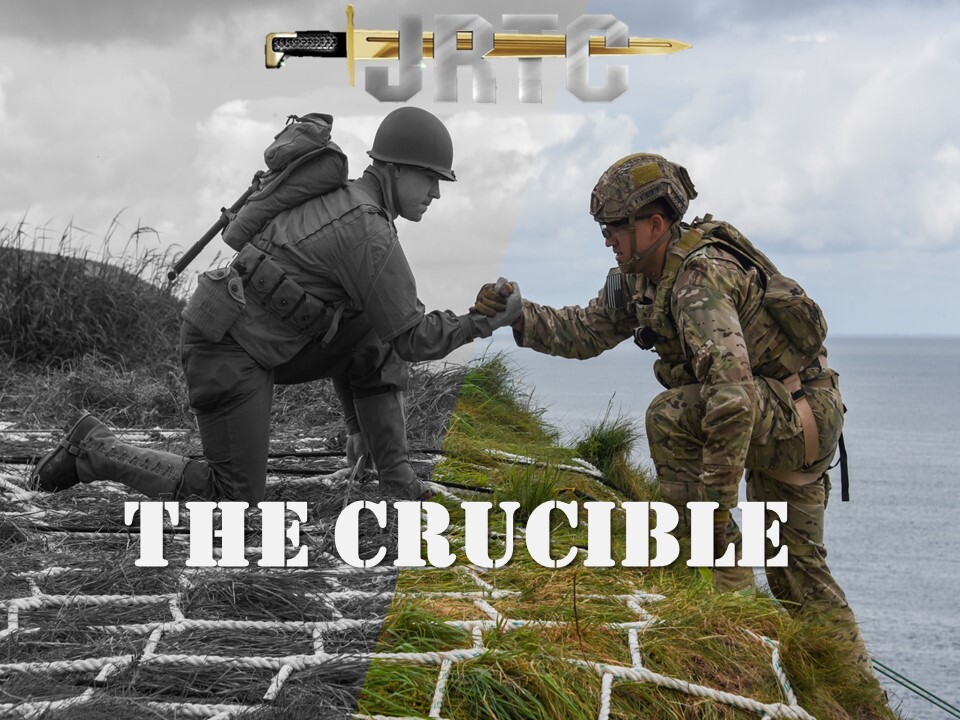
The Crucible
The crucible that is the JRTC experience is an arduous ordeal every unit must go through to certify their readiness. It tests every leader and the unit collectively physically, mentally, and morally and is the defining experience of collective training. The crucible takes place over fourteen days of force-on-force as part of a decisive action training exercise, where leaders and units are continuously food & sleep deprived, harassed by opposition forces, and generally under duress.
The bottom line is this—the crucible at the JRTC is a rite of passage that, through shared sacrifice, leaders and units will never forget. With that memory and the core warfighting skills honed throughout this training exercise, they will be able to face any challenges in their path allowing them to fight and win on the modern battlefield.